Monday, October 26, 2009

The Courage to Create

In his book, The Courage to Create, Rollo May explores the dilemma of the truly creative act, to envision and make art despite the chaos and brutality of the world. He points out that imagining new forms, new symbols and new patterns that can open the way to a new society takes the guts to reach through the ego's tight grip and caress the churning forces beneath the surface of the known world.
Often, we think of creative work as an escape or transcendence of daily life's boredom and conflict. Yet, this is the mind dabbling in fantasy. It can produce work that is pretty or intellectually intriguing. But, like the empty calories of an sugar cube, the sweetness stimulates the tongue, while the body starves. The courage to create is the courage to stop looking in the rear view mirror for creative inspiration and enter the unknown territory ahead. It is to perceive what is being born through the clouds of fear and hope and facilitate what can deeply nourish the birth of the new. The courage to create slices through the ego's worries about criticism and disappointment and risks utter failure in the vain attempt to describe the indescribable. It allows the life force gnawing at your belly to express itself unedited by current beliefs of what is politically or spiritually correct. The courage to create is the courage to live. It is the most difficult act to engage. Yet without the courageously creative acts of artists from every walk of life, our days would be dull, uninspired and humorless.

On the other hand, courageous creativity doesn't have to be an heroic feat of monumental proportions. We don't have to redesign cities, hang paintings on MOMA's walls, or cure cancer to make courageous gestures of creativity. In a moment, we can open our minds and bodies to a direct, unfiltered encounter with where we stand, who we are with and what we are doing. In that spacious moment, we can see we are already swimming in the currents of a courageously creative universe. We can see that that all we are being called to do is willingly participate.

Monday, October 12, 2009

John Muir's Green Architecture

In 1869, John Muir attached a wooden shack to the saw mill near the base of Yosemite Falls. He lived there two years listening to the music of the rushing water. Through the hole in the roof, Muir gazed at South Dome, Yosemite Falls, and the stars. Living in the nave of nature's cathedral inspired him to write: "Climb the mountains and get their good tidings. Nature's peace will flow into you as sunshine flows into trees. The winds will blow their freshness into you and the storms their energy, while cares will drop off like autumn leaves."

Muir's green architecture was not about reducing his carbon footprint. It's wasn't about the latest politically correct style. Instead, this funky, little shack established a receptacle for guiding the forces of nature into his senses and his soul. Living there, Muir entered an intimate communion with the wisdom and revitalizing power of ecological processes. There, he learned what nature actually was and learned his place within it. That encounter and many others powered his life's work of looking through the outer appearances of mountains and trees, boulders and water, bears and birds and seeing the spirit speaking at their core. He got beyond the idea of nature and engaged in a direct dialogue with it.

In our rush to green the planet, we would do well to remember John Muir's wooden perch at the base of Yosemite Falls. We would do well to follow his lead and listen to the songs of water and wind and to hear the silence of granite and pine. Before drawing the lines of floor plans, we could trace the lines of tree bark and gravity. Before raising the roof, we could raise our eyes to receive the designs of hawk wings and cloud paths. What we find could flow into our cities and our homes. The energy of storms and the freshness of the wind would cancel out our carbon footprint and guide us toward architecture that was a vital and nature itself.

Friday, October 9, 2009

Architecture & Death

Yesterday, my friend, Rob Buck, died. Hearing that the light has left the eyes of this intelligent, strong, loving man fills me with sadness. Yet, as Rob's life gave those who knew him a gift, his passing leaves a gift. The ache of Rob's death frames the light of the spirit that was always shinning in him and in us. We think of a person's life as the sum of what he or she does and judge them by the results of those actions. We define them by the physical forms they present. Yet, Rob's passing points toward a different view. Maybe what matters is how a person's actions and forms frame the light of the spirit that animates those actions. Maybe what matters is the light reflected from the physical forms they create. Maybe how skillfully they radiate the light is secondary to how much we open our eyes and hearts to see it. Maybe the physical architecture of a life matters, but the real purpose of its walls and roofs, doorways and windows is to frame the light, love and wisdom of the soul.

Friday, September 25, 2009

Feel the Tug of the Heavens in Your Hands

Last Saturday on Marina Green in San Francisco, the community celebrated Family Kite Day. Hundreds of people of all ages and styles stood on the field by the bay holding strings and gazing skyward as their kites of all designs fluttered in the breeze. Some flyers guided their kites through intricate swoops and soars, dancing their kites to the music blasting from speakers positioned along the sidelines. Others simply felt the tug of the heavens from their place on earth. The sight was joyous and freeing. How great it is when we can feel the heavens tugging in our hands as we stand on the solid earth.

Thursday, September 24, 2009

Freedom Beyond the Grid

Out beyond ideas of wrongdoing and rightdoing
there is a field. I'll meet you there.

When the soul lies down in that grass,
the world is too full to talk about.
Ideas, language, even the phrase each other
doesn't make any sense.
- Rumi

We spend so much energy and attention constructing our grids of right and wrong, me and world, that we forget there is something more. We forget that beyond the lines of self-created divisions and fragments there is the fullness of just being. When, by some chance of fate, our grid of ideas breaks open and we enter that field of freedom, it only lasts a moment. Then the mind has a spasm of rear and and snaps the thought grid back over our eyes.

Wanting to have our cake and eat it, we look for ways to have our grid of ideas and also live in the field beyond ideas. So we search for a grid that ties the world together rather than dividing it up. We look for networks, webs, and matrixes that connect the dots and reveal the hidden picture that makes sense out of the chaos. Yet, these types of grids is that offer visions of truth actually conceal it. Ultimately, every matrix that explains the world reaches a point where it encounters information and experience that it cannot explain. It encounters the messy life that is actually happening while we are busy weaving our neat and clean grid of explanation.

When we discover the limits of our grid and it starts to crumble, most of us rush to mend the grid. We scurry about trying to force the field beyond ideas back into the box of ideas. Then life breaks the boxes open again and the cycle of reconstructing the grid goes for another round.

Rumi sees our struggle with life and invites us to meet him in the field waiting just beyond the lines. He points to the abundant picnic waiting there. It's only a step beyond an intersection of lines. After feasting in that field, we can return to our beloved matrix of beliefs and explore the delights of making connections. Instead of drawing lines that divide up the world, our grids can become windows that point beyond themselves toward that rich field of freedom.

Tuesday, September 22, 2009

Freeing Earth From Thought Grids

This is Earth on your thoughts. Each of us uses a grid of beliefs to navigate the terrain of life. With this thought grid, we categorize ourselves, society, nature and anything else that that passes through our minds. It defines if we stand on the political left or right; the work we consider high and low; the people we push away and those we pull close. Our thought grid outlines our network of community and our links to ecological web.

Everything we encounter is immediately filtered through our thought grid. Is the face passing on the street beautiful or ugly? Is the food on the plate tasty or bland? Is that fragrance on the breeze sweet of putrid? From the moment we open our eyes in the morning to the moment we close them at night we take the vastness of the world and squeeze it between the lines of our belief grid.

On the one hand, a grid of categories is essential. The body separates digestible grains from indigestible pebbles. It divides warm, dry habitable rooms from cold, damp inhabitable boxes. It's helpful to agree that red light mean stop and green lights mean go. On the other hand, most of the categories in our belief grids are merely preferences. Salad is not really better or worse that soup. Red is not closer to the truth than blue. Gold is not really more valuable than lead.

Clashing thought grids result in wars, arguments, oppression, persecution and all manner of conflicts. Thought grids that attempt to harness and control the ecosystem cause pollution, fragmentation and the loss of plant and animal species.

Thought grids are as essential to being human as breathing. Our brains are grid making machines. By their very nature they distinguish light from dark, gain from loss, earth from sky, self from other. The problem is that we attempt to make them solid and fixed rather than allowing them to be transparent and fluid. When we can see through a flexible grid, we can maintain healthy boundaries while being responsive the changes circumstances. There is much more to say about this. But, for now, perceive the grid of beliefs shaping your thoughts and imagine it as a shifting gauze rather than unmoving steel.

Monday, September 21, 2009

View From the Threshold of Death

On Saturday, I went to an exhibit called The Way of the Samurai. It described the principle of bushido, which includes living each moment as if looking back from the moment of death. Rather than being morbid or scary, this viewpoint opened my mind and senses to the richness of the here and now with a power I hadn't quit experienced before. The world became both more vivid and dreamlike, more intimate and universal, more engaging and freeing. What I do with my days mattered more, but without the pressure of grasping each grain of time. Facing death openly sparked the life forces within me.

Later I asked, "What dies?" Some would say the body and not the soul. Some would say nothing dies; they only change form. I couldn't honestly answer the question. I realized that wanting to pin life down would be like wanting to pin down the wind or the ocean. And that would really be death. Instead, I just perched on the threshold of life and peered into the dreamlike reality of living each moment.

Wednesday, September 16, 2009

Freeing The Dark Heart

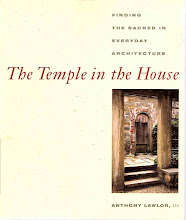
"A bit touchy feelly don't you think?" A man with dull eyes confronted me with this question as I walked off the stage to wild applause following a lecture at the Graham Foundation in Chicago. Why is touching and feeling something so frightening? "Who do you think you are, Joseph Campbell?" a "friend" asked after reading three sample chapters from my first book, The Temple in the House. How can self expression be so threatening? Mocking laughter was my father's response when I told him I wanted to be an architect. Why would a man would want to crush the dream of his progeny? Imagine you have encounters with spirit killing comments almost daily.

The grip of these types of comments loosened when I realized they were expressions of fear. At the same time, I realized their cumulative effect is devastating. This is because, more than spreading fear, they promote the withholding of life energy. Bit by bit, this withholding turns the heart dark. Bit by bit, the cold lightless heart becomes a place where brutality is born.

I realized other possibilities at the Chapelle du Rosaire de Vence in southern France. This luminous space was designed and decorated by Matisse. In the playful colors and delicate forms I saw the courage in tenderness. Our action heros are hard and loud. But in this little chapel I encountered a great power in softness and silence. The darkness in my heart found a place where the life energy it had withheld could be released and be free.

Tuesday, September 8, 2009

The Wildness of Carrots

At a farmers' market this weekend, these carrots jumped out at me. Certainly, I've looked at carrots, chopped them, grated them, eaten them. In the vegetable stall that day, I encountered their wildness.

Imagine how they come into being. Sinking into the soil's darkness, they twist toward the core of the earth. At the same time, they're reaching for the sun. The green tops pull down the solar radiance and pour it into the root. Underground, the color of sunset glows, waiting for it wild sweetness to be discovered.

Monday, September 7, 2009

The Power of Roadside Shrines

Beside the footpath along Corte Madera Creek near my house sits this shrine. It's too far from the closest street to mark the spot of a traffic fatality. Nothing suggests it honors the memory of a fallen celebrity. Instead, Buddha and his pal just hang out in their ring of stones radiating peace. I'm not sure how they got there. I assume the person who lives behind the gate on the opposite side of the footpath placed them and maintains this unassuming shrine. Some days Buddha cups a tangerine in his hands. Other days it's flowers, beads, or some other object. Every time I pass this way, I thank them for their silent gift to the community. I appreciate the simplicity and the lack of "Hey, look at the wonderful gift I have given you!!!"

In other countries, these kinds of shrines are common. As I suggested earlier, they are not intended to mark auto accident sites, but to honor some elusive quality of dwelling on earth. In densely populated cities, I've happened across shrines reminding passersby that amidst the clammer of the marketplace there is stillness, tenderness and artfulness. On isolated mountain trails, at the points where uphill climbs cause the body to scream for rest, someone has often placed a bench. In these places, support and spaciousness form the shrine. In Nepal, trekking northeast from Kathmandu, I found a series of stone benches carved with Tibetan deities. Dotting Paris, fountains where the three muses dance offer water. If you've traveled, I'm sure you've passed shrines such as these. Along the road, these little gems inspire the journey.